
 Eleanor Nightbloom
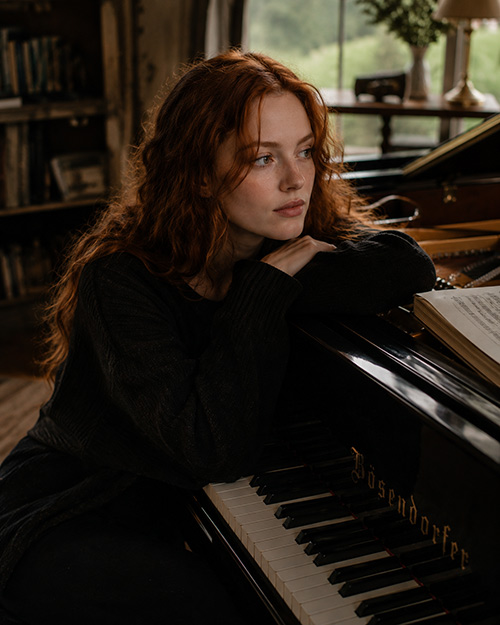
 ARTIST HISTORY
Eleanor Nightbloom is a Scottish composer and pianist whose music bridges the elegant architecture of neoclassical composition with the lyrical warmth of new age piano. Her works are characterized by flowing melodies, rich harmonic progressions, and an understated emotional sincerity that has attracted listeners seeking music that is both comforting and deeply expressive. Rather than pursuing technical spectacle, Eleanor believes that the most memorable melodies are often the simplest, provided they are given room to breathe.
Born in 1995 in Inverness, in the Scottish Highlands, Eleanor spent her childhood on the outskirts of the city overlooking the River Ness. Her mother worked as a botanical illustrator, while her father was a lighthouse engineer whose work frequently took him along Scotland's rugged northern coastline. Their home was filled with pressed wildflowers, antique maps, and shelves overflowing with books about nature, folklore, and astronomy. Even before she began formal music lessons, Eleanor associated creativity with quiet observation, often spending afternoons sketching trees or watching mist settle across the hills outside her bedroom window.
She began studying piano at the age of seven after her grandmother rescued an aging upright piano from a closing church. Though its keys were uneven and several strings buzzed slightly, Eleanor adored its imperfect voice. She developed an unusually patient approach to practice, preferring to spend hours refining the character of individual phrases rather than learning large amounts of repertoire. Her first teacher remarked that Eleanor played "as though she were telling someone a secret."
During adolescence she became fascinated by the relationship between memory and music. She kept journals in which every original composition was accompanied by handwritten notes describing the place, weather, scent, or conversation that had inspired it. Years later she would revisit those journals not to recreate the memories themselves, but to rediscover the emotional atmosphere surrounding them. Many listeners believe this habit contributes to the unusually vivid sense of place found throughout her music.
Eleanor went on to study Piano Performance and Composition at the Royal Conservatoire of Scotland in Glasgow. There she immersed herself in harmony, orchestration, and contemporary composition while developing a growing appreciation for the works of Gabriel Fauré, John Ireland, Marianelli, Dustin O'Halloran, and Joep Beving. Their ability to communicate profound emotion through restraint rather than excess became a guiding principle in her own work.
While still a student, Eleanor experienced what she describes as a defining musical revelation after hearing several recordings performed on a Bösendorfer Imperial. She was particularly captivated by recordings of Valentina Lisitsa performing impressionist repertoire and Paul Lewis performing the late piano works of Franz Schubert. The Bösendorfer's singing treble, velvety middle register, and famously resonant bass left a lasting impression on her. Unlike many concert instruments she had encountered, it seemed capable of sustaining harmonies with an almost orchestral richness while preserving extraordinary clarity. From that moment onward, the Bösendorfer became her dream instrument and remains her preferred piano for both recording and performance whenever one is available.
Outside of composing, Eleanor enjoys restoring antique botanical books, photographing moss-covered stone walls after rainfall, and collecting handmade ceramic tea cups from local artisans she encounters while traveling. Friends describe her as quietly witty, endlessly patient, and someone who never arrives anywhere without a notebook tucked into her coat pocket. She often says that melodies rarely appear while sitting at the piano; instead, they emerge unexpectedly during long walks through forests, train journeys, or while tending the small greenhouse behind her cottage.
Today, Eleanor Nightbloom continues to compose music that invites listeners into moments of calm, reflection, and quiet optimism. Her works balance classical craftsmanship with contemporary accessibility, creating sound worlds where graceful harmonies and lyrical melodies unfold naturally. Whether heard in a concert hall or through headphones during a solitary evening walk, her music reflects her enduring belief that beauty often reveals itself not through grandeur, but through gentle attention to the smallest details. Her debut album on Mythical Piano Records, Pale Kingdom of Autumn Desires, was released in 2026.