
 Anneliese Falkner
 ARTIST HISTORY
Anneliese Falkner is an Irish composer and pianist whose music inhabits the delicate space between impressionism, new age, and contemporary classical composition. Known for her luminous melodies, spacious harmonies, and emotional subtlety, she creates music that invites listeners into moments of reflection and quiet wonder. Her works often draw inspiration from nature, memory, and the changing landscapes of the Irish coast, blending classical craftsmanship with a modern sensitivity to atmosphere and mood.
Born in 1991 in the seaside town of Dingle on Ireland's southwest coast, Anneliese grew up surrounded by dramatic cliffs, rolling green hills, and the constant presence of the Atlantic Ocean. Her mother was a marine biologist and her father restored antique furniture, creating a home where curiosity, patience, and creativity were woven into daily life. Much of her childhood was spent exploring tide pools, collecting unusual stones from the shoreline, and listening to stories told by older fishermen in the harbor. Those early experiences nurtured a lifelong fascination with the beauty hidden in small, often overlooked moments.
Anneliese began studying piano at the age of eight after discovering an old upright piano in a community hall near her home. While other children were drawn to sports and competition, she found herself captivated by the instrument's ability to express feelings that words could not. Her teachers quickly recognized her sensitivity to tone and phrasing, though she was known more for her imagination than technical brilliance. Even as a teenager, she preferred composing short musical sketches inspired by weather, landscapes, and dreams rather than performing showpiece repertoire.
She later attended the Royal Irish Academy of Music in Dublin, where she earned degrees in both Piano Performance and Composition. During her studies, she developed a deep appreciation for the music of Frederic Mompou, Toru Takemitsu, John Field, Nils Frahm, and Valentin Silvestrov. Their ability to create profound emotional depth through restraint and simplicity left a lasting mark on her artistic voice. She became particularly interested in the role of silence in music, often describing rests as "the places where listeners find themselves."
After graduating, Anneliese spent several years living in different parts of rural Ireland, supporting herself by teaching piano lessons while composing in the early mornings. During this period she developed the writing style that would eventually define her career. Rising before dawn each day, she would sit at the piano with a cup of tea and compose while the world was still quiet. Many of her most beloved works originated during these solitary hours, when the boundaries between memory, imagination, and music seemed to dissolve.
Listeners often describe her music as peaceful, nostalgic, and deeply comforting. While primarily known for solo piano compositions, she frequently incorporates subtle string textures, field recordings, and ambient elements drawn from the natural world. The sound of rain against a window, distant church bells, ocean waves, and birdsong have all found their way into her creative process. Rather than viewing these sounds as background noise, she considers them collaborators in her work.
Away from music, Anneliese is known for her thoughtful and down-to-earth personality. She enjoys hiking coastal trails, restoring vintage books, gardening, and baking traditional Irish soda bread from her grandmother's handwritten recipe. Friends often describe her as someone who listens more than she speaks and who has a gift for making people feel at ease. She is also an avid journal keeper and has filled dozens of notebooks with sketches, observations, poems, and fragments of melodies collected over the years.
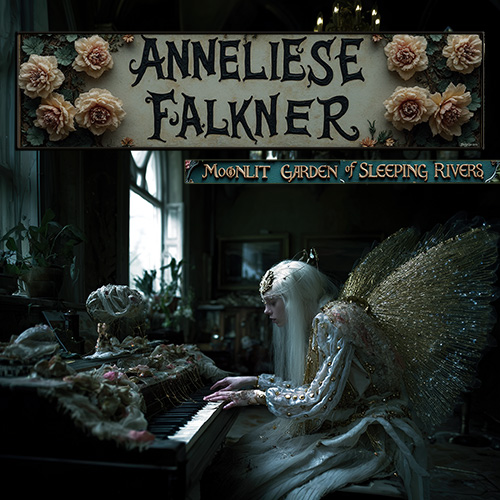
Today, Anneliese Falkner's music reaches listeners around the world who are seeking beauty, stillness, and emotional connection in an increasingly busy age. Her debut album on Mythical Records, Moonlit Gardens of Sleeping Rivers, was released in 2026. Despite a growing international audience, she remains deeply connected to the landscapes that shaped her imagination, continuing to create music that reminds listeners to slow down, pay attention, and find meaning in the quiet spaces of life.