
 Amalia Rosenauer
 ARTIST HISTORY
Amalia Rosenauer is a Russian composer and pianist whose music inhabits the space between new age, impressionism, and contemporary classical. Her compositions are known for their luminous textures, delicate harmonies, and emotional honesty, inviting listeners to slow down and reconnect with themselves. Blending the atmospheric beauty of impressionist music with the introspective spirit of modern piano composition, she creates works that feel both timeless and deeply personal.
Born in Kazan in 1994, Amalia grew up in a modest apartment overlooking a busy tram line. Her earliest memories are filled with the sounds of daily life blending with music: the distant hum of traffic, rain against the windows, and the upright piano that occupied a place of honor in her family's living room. Her mother worked as a literature teacher and her father as a civil engineer, neither of them professional musicians, but both passionate advocates for the arts. They encouraged curiosity above all else, filling their home with books, records, and spirited conversations about history, science, and culture.
Amalia began studying piano at the age of six. While she showed natural talent, she was not considered a child prodigy. Instead, she developed through persistence, imagination, and an unusual sensitivity to sound. Teachers often noticed that she would spend as much time improvising as she did practicing assigned repertoire. By her early teens she had developed a habit that continues to this day: keeping a notebook beside the piano to capture musical ideas, observations, dreams, and fragments of poetry.
She later attended the Kazan State Conservatory, where she studied piano performance and composition. During her years there, she became fascinated by the works of composers such as Claude Debussy, Maurice Ravel, and Alexander Scriabin. Their emphasis on color, atmosphere, and emotional nuance left a lasting impression on her artistic voice. At the same time, she found inspiration in contemporary composers and ambient musicians who demonstrated that simplicity could be just as powerful as complexity.
After graduating, Amalia spent several years traveling throughout Russia by train, carrying little more than a suitcase, a notebook, and a portable keyboard. Those journeys became a defining influence on her music. Long hours spent watching forests, villages, and snow-covered landscapes pass beyond the train window fostered a sense of reflection that continues to shape her compositions. Many listeners describe her music as cinematic, though she prefers to think of it as "music for inner landscapes."
Outside of composing, Amalia is known for her quiet, approachable personality. She has spoken openly about struggling with self-doubt and perfectionism, experiences that many of her listeners find relatable. Rather than hiding those challenges, she incorporates them into her creative process, believing that vulnerability creates connection. She often says that some of her favorite compositions began as unfinished sketches she nearly discarded.
Away from the piano, she enjoys tending a collection of houseplants, collecting antique postcards from flea markets, and taking long walks regardless of the weather. Friends describe her as someone who notices small details others overlook: the changing color of evening light, the rhythm of footsteps on cobblestones, or the particular silence that follows a snowfall.
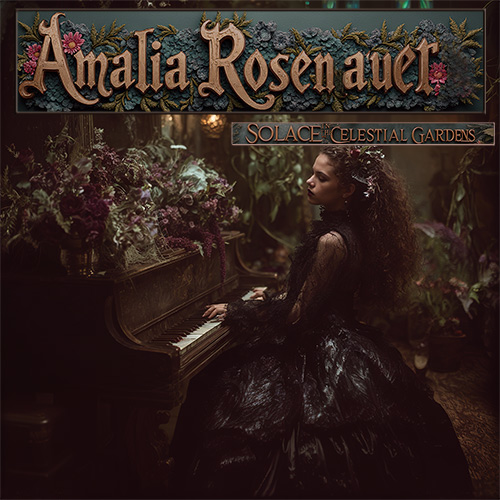
Today, Amalia Rosenauer continues to compose and perform for audiences around the world. Her music has found a devoted following among listeners seeking beauty, contemplation, and emotional resonance in an increasingly fast-paced world. Her debut album on Mythical Records, Solace in the Celestial Gardens, was released in 2026. Whether heard during moments of study, reflection, healing, or simple quiet, her compositions offer a gentle reminder that there is meaning to be found in stillness, and that even the smallest moments can contain extraordinary depth.